Compliance programs outgrow spreadsheets fast
Stormwater devices, bridges, culverts, sewers, signs, pavement — regulators expect every one inventoried, inspected on a recurring schedule, condition-scored, and reported on their format. Most agencies run this on spreadsheets, paper, and tribal knowledge.
Overdue Until It's an Audit Finding
Spreadsheets don't escalate. A missed re-inspection stays invisible until the regulator, or a failure, finds it first.
Years & Millions for Bespoke EAM
Purpose-built enterprise asset-management replacements take years to deploy and demand licensing plus custom development that only grows.
Proprietary Data Lock-In
Legacy vendors trap your asset history in proprietary models — painful migrations, and hard audits exactly when you need transparency.
Modular by design. One Salesforce org.
Pick only the modules your program needs — each deploys on standard PSS objects with no proprietary layer, and coexists with permitting, grants, and 311 on the same org.
Asset Register & Inventory
- Standard-object register: types, criticality, districts
- GIS location & element-level features
- Lifecycle status: Current / Due Soon / Overdue / Expired at a glance
Inspection Lifecycle & QC
- Typed field inspections with checklist attributes
- Deficiency flagging with severity & defect coding
- Permission-gated District → HQ approval — only approved results become official
Condition Scoring
- Numeric score → condition band → recommended action
- Any domain scale: PCI 0–100, NBIS 0–9, PACP 1–5
- Temporal model: current, prior & historic inspections
Scheduling & Maintenance
- Risk-based intervals by asset type & criticality
- A severe defect pulls the next inspection forward — automatically
- One work order per deficiency, no Field Service license
GIS & Offline Mobility
- Map-first office console; ArcGIS bridge tier
- Offline tablet capture in the field — tiered: Briefcase, first-party Field App, or Axsy
- Per-inspector check-out scoping for large estates
Reporting & Regulator Exports
- License-free analytics workbench: aging, condition mix, turnaround
- Operational reports & due-for-reinspection views
- CSV export engine mapped to NBI/SNBI, MS4, PACP
From field capture to regulator report, end-to-end
A single demo takes one asset through inspection, QC approval, condition rollup, corrective work order, and the regulator export — on a standard Salesforce org, no slideware.
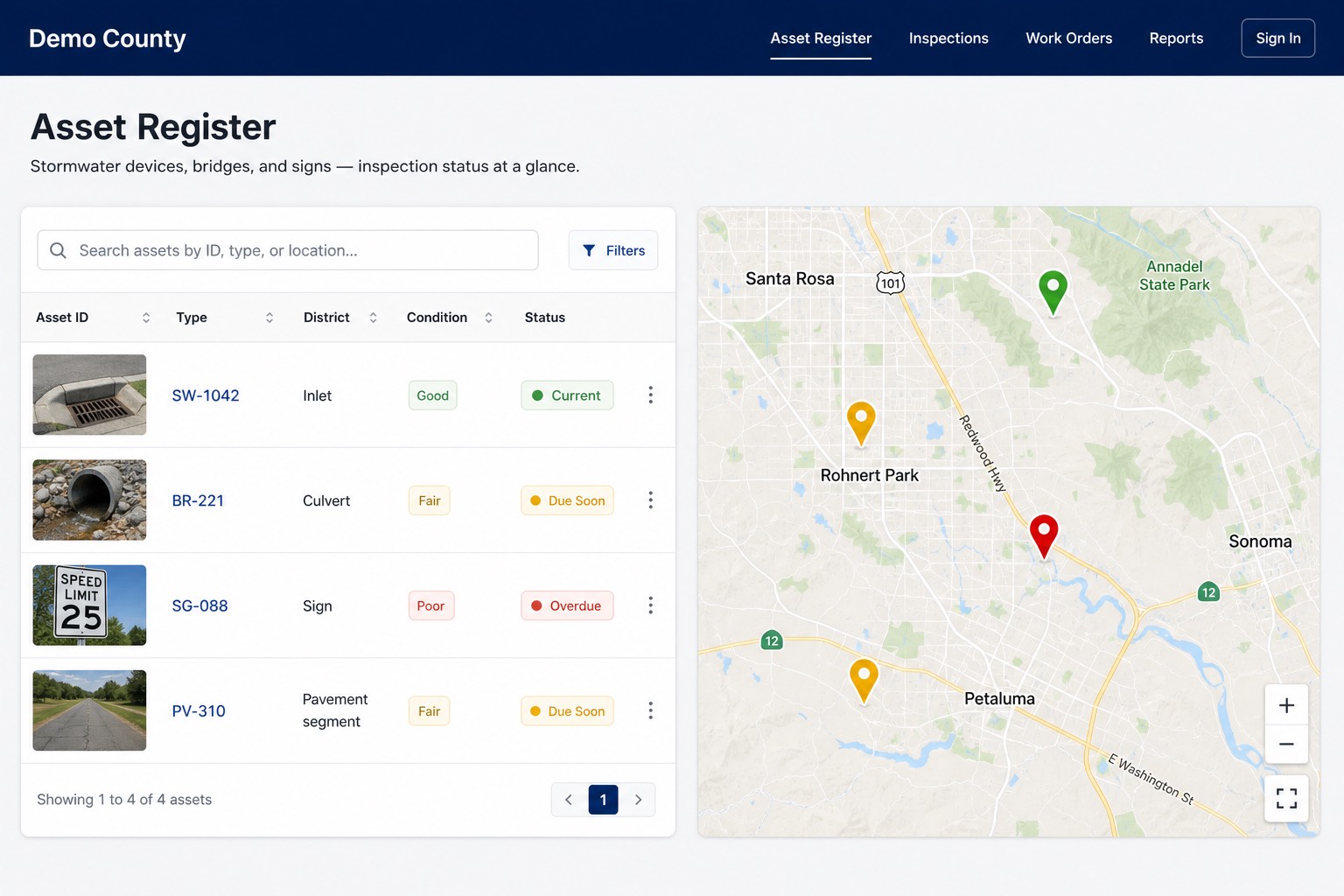
Your whole estate, one screen
Every device, structure, or segment with its type, criticality, condition band, and inspection status — on a list and on a map.
- Due-for-reinspection list views out of the box
- Click an asset to see its full inspection history
- Reposition with GIS QC review — authoritative coordinates protected
Inspect where there's no signal
Inspectors check out their route, work fully offline on a tablet, and sync when they're back — checklists, scores, deficiencies, photos.
- Per-inspector device scoping keeps syncs small
- New assets registered in the field slot straight into the model
- Defect coding with severity on every finding
The office decides what becomes official
District reviews, HQ approves. Only an approved inspection becomes the asset's current condition — and the approval is permission-gated and audited.
- One-click approve from the review queue
- Built-in integrity audits: exactly one current inspection per asset
- Return-to-inspector path for rework
Severe defects can't hide
On approval, the condition rolls up, a work order is raised per deficiency, and the next inspection date is computed once — the sooner of the routine schedule and the defect-driven rule.
- Severity drives work-order priority
- High-severity finding? The re-inspection moves up automatically
- Complete finding → fix → re-inspection trail
Regulator-ready in one click
The analytics workbench shows aging, condition mix, and program throughput without an analytics add-on; the export engine emits your regulator's format from configuration.
- Median & P90 turnaround, backlog aging
- NBI/SNBI, MS4, PACP export mappings as config rows
- Standard reports & dashboards for daily operations
Beyond spreadsheets and bespoke EAM
No forks. No proprietary lock.
- Standard PSS data model (Asset, inspection Visits, WorkOrders) — no proprietary layer, no data lock-in
- Configuration over code: condition bands, frequencies, re-inspection rules, and regulator exports are metadata rows
- Generation factory turns your device types and program rules into working configuration in days — behind a test-first quality gate
- GIS, offline mobility & dispatch are swappable tiers; a license-dependency check states what your scope needs, and what it does NOT
- Coexists cleanly with permitting (LPI), grants, and 311 on one org
Real agency outcomes
- Regulator-ready: overdue status on every asset; a severe open defect can never hide behind a routine re-inspection date
- Field crews work offline; QC keeps the office in control of what becomes official
- A complete finding-to-fix trail: deficiency → work order → re-inspection, automatically
- Proven pattern: built and hardened on a Caltrans-class stormwater (NPDES/MS4) device-inspection program
One engine, any inspection domain
The product ships domain-neutral; your domain arrives as configuration — asset types, condition scales, frequencies, defect codes, and export mappings.
From scoping to live in three phases
Fixed-price QuickStart scoping keeps the budget predictable. Go-live is measured in weeks, not quarters.
Discover & Scope
Map your asset types, condition scales & inspection frequencies; pick modules; confirm the license matrix (mobility & GIS tiers). Output: a fixed-scope SOW.
Generate & Configure
The generation factory scaffolds your types, bands & schedules, wires the mobile tier, and deploys a right-sized footprint to your sandbox — then UAT.
Go Live & Extend
Field rollout with QC training and regulator exports, then managed upgrades — add GIS, dispatch, or new domains as programs grow.